CelestAI
generative models for astronomical image synthesis
Project metadata
Overview
A comparative study of four generative models (DCGAN, StyleGAN, VAE, VQGAN) for synthesizing rare astronomical images, measuring whether synthetic augmentation improves rare-event detection on the Galaxy10 DECals dataset.
Problem
Astronomy's rarest phenomena, including gravitational lensing, kilonovae, and fast radio bursts, occur infrequently, which severely limits observational data and hampers analysis. CelestAI tests whether generative models can produce synthetic yet realistic astronomical images to close that gap.
Dataset
Galaxy10 DECals, an enhanced version of the original Galaxy10. 17,736 colored galaxy images at 256x256 pixels in g, r, z bands, sourced from the DESI Legacy Imaging Surveys and labeled by Galaxy Zoo volunteers.
Ten morphological classes: Disturbed, Merging, Round Smooth, In-between Round Smooth, Cigar Shaped Smooth, Barred Spiral, Unbarred Tight Spiral, Unbarred Loose Spiral, Edge-on without Bulge, Edge-on with Bulge. Class counts range from 334 to 2,645 images.
Evaluation method
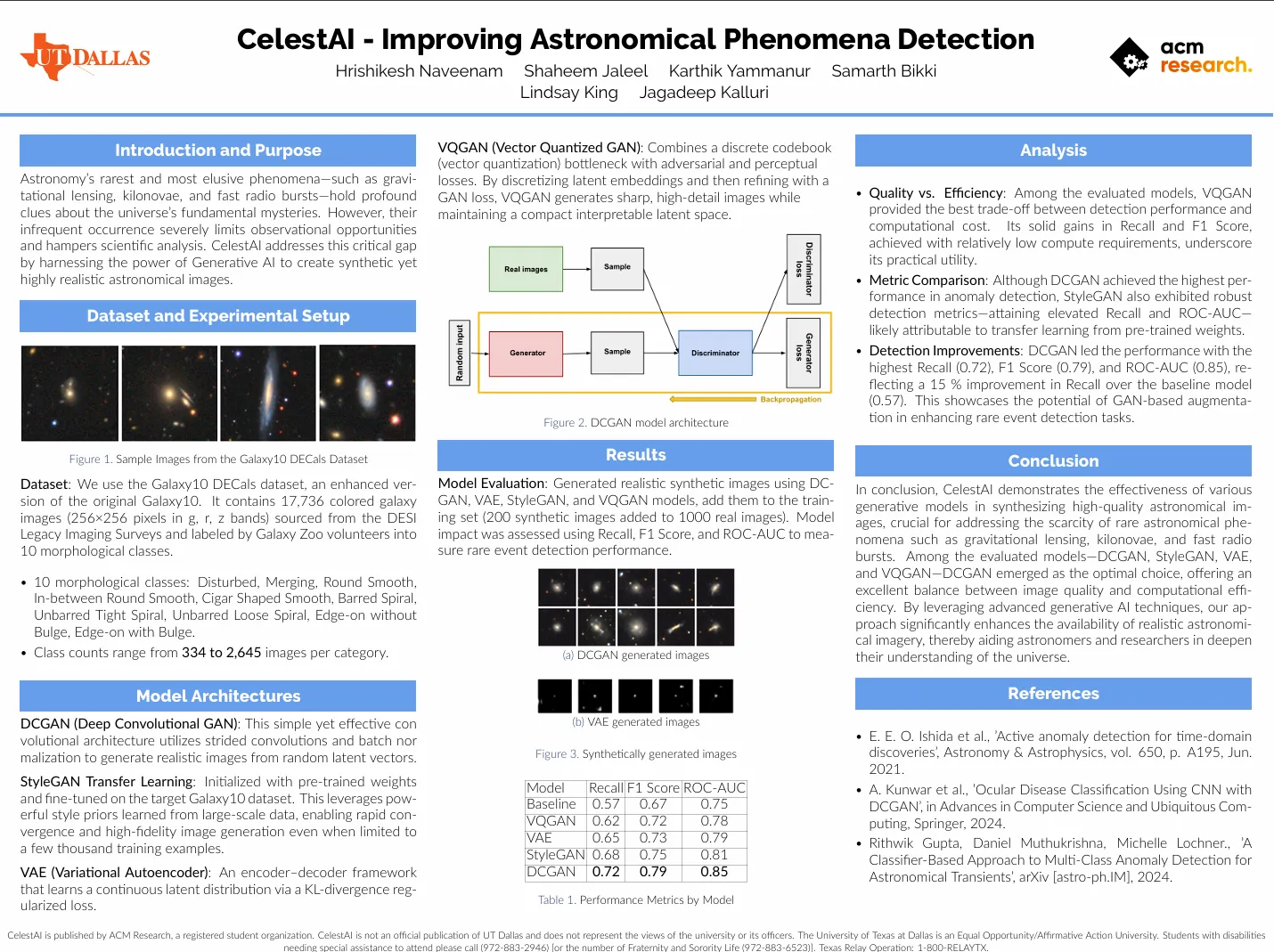
Generated synthetic images with each model, added 200 synthetic images to 1,000 real images, and assessed rare-event detection performance using Recall, F1 Score, and ROC-AUC.
Results
Qualitative comparison
Analysis
- Quality vs. efficiency: VQGAN provided the best trade-off between detection performance and computational cost, achieving solid Recall and F1 gains at relatively low compute.
- Metric comparison: DCGAN achieved the highest anomaly detection performance. StyleGAN also showed robust metrics with elevated Recall and ROC-AUC, likely attributable to transfer learning from pre-trained weights.
- Detection improvement: DCGAN led with Recall 0.72 against a 0.57 baseline, a gain of 15 percentage points (26% relative).
Conclusion (from the poster)
CelestAI demonstrates the effectiveness of generative models in synthesizing high-quality astronomical images to address the scarcity of rare astronomical phenomena. Among the four evaluated models, DCGAN emerged as the optimal choice, offering the best balance between image quality and computational efficiency.
References cited on the poster
- E. E. O. Ishida et al., "Active anomaly detection for time-domain discoveries," Astronomy & Astrophysics, vol. 650, p. A195, Jun. 2021.
- A. Kunwar et al., "Ocular Disease Classification Using CNN with DCGAN," in Advances in Computer Science and Ubiquitous Computing, Springer, 2024.
- R. Gupta, D. Muthukrishna, M. Lochner, "A Classifier-Based Approach to Multi-Class Anomaly Detection for Astronomical Transients," arXiv [astro-ph.IM], 2024.
Full stack
Python · TensorFlow · NumPy · Matplotlib · Google Colab
Results
Dataset | Multimodal Universe Legacy Survey (HuggingFace), per repo README + `vae.ipynb` | |
Augmentation setup | 200 synthetic + 1,000 real | |
Best model | DCGAN, Recall 0.72 / F1 0.79 / ROC-AUC 0.85 | |
Recall gain over baseline | +15 percentage points (0.57 → 0.72), +26% relative | |
F1 gain over baseline | +12 percentage points (0.67 → 0.79), +18% relative | |
Placement | 3rd place among 10+ ACM Research teams |